- label Products and novelties
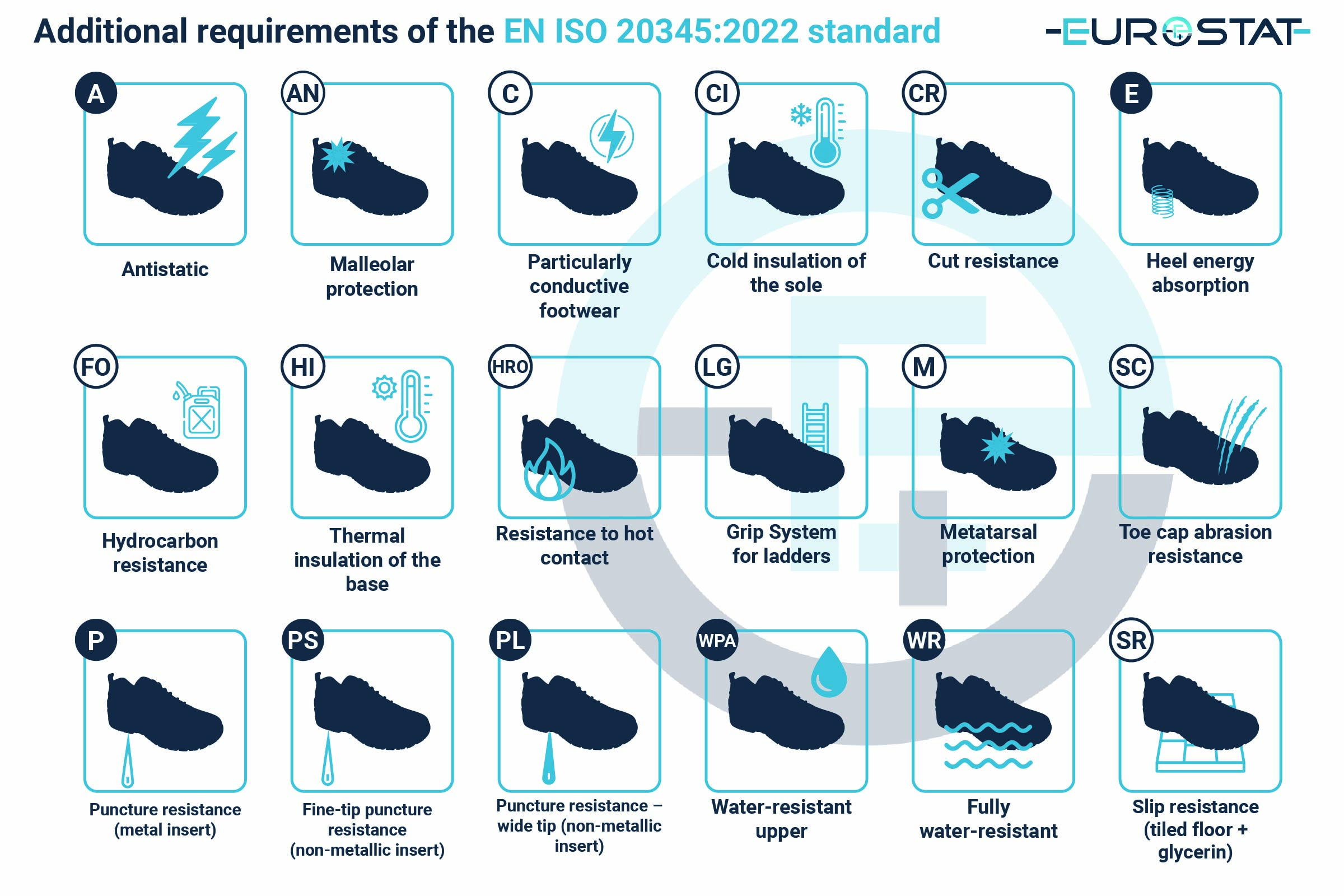
Choosing compliant ESD footwear is not just a matter of ticking the "antistatic" box on a purchase order. Between EN ISO 20345 and EN ISO 20347, the markings S1, S2, SB and O2, the supplementary codes HRO and FO, and the IEC 61340-5-1 requirement specific to ESD Protected Areas, the choice requires a precise reading of the label.
This article explains how to decode these markings, why an antistatic shoe is not necessarily an ESD shoe, and how to select the right model based on the actual constraints of your working environment. Three Eurostat models serve as concrete examples: a multi-hazard safety shoe for heavy industry, a lightweight occupational shoe for clean environments, and an ESD clog for medical or food industry use.
ESD vs antistatic footwear: a distinction with real consequences on the floor
The two terms describe very different levels of electrostatic protection. Confusing them can lead to non-compliant equipment in an EPA, with real risk to sensitive components.
Antistatic footwear (marking A)
Electrical resistance between 100 kΩ and 1,000 MΩ. It reduces the risk of spark ignition in flammable or explosive environments by dissipating the operator's static charge. It does not guarantee sufficient grounding to protect electrostatic discharge sensitive components.
ESD footwear (IEC 61340-5-1 compliant)
Electrical resistance between 100 kΩ and 35 MΩ, a tighter and better-controlled range. It ensures continuous operator grounding in an ESD Protected Area. This is the level required by IEC 61340-5-1 for handling electrostatic discharge sensitive devices.
Key point: antistatic footwear protects the operator from spark risk. ESD footwear protects components from unintentional electrostatic discharge. For any EPA, only IEC 61340-5-1 compliant ESD footwear is accepted.
EN ISO 20345 or EN ISO 20347: which standard for which workstation?
This is the first decision to make before looking at supplementary markings. The two standards cover different risk levels.
| Standard | Key characteristic | Typical environments |
|---|---|---|
| EN ISO 20345 | Mandatory protective toecap (200 J impact resistance). Categories S1, S2, S3, SB. | Industry, logistics, maintenance, any workstation with crushing or falling object risk |
| EN ISO 20347 | Professional occupational footwear without mandatory toecap. Categories O1, O2, OB. | Medical, pharmaceutical, food industry, laboratory, cleanroom, workstations without crushing risk |
Choosing the wrong standard exposes the employer to regulatory non-compliance. An electronics assembly operator working near industrial transport equipment may require EN ISO 20345, while a cleanroom technician with no mechanical risk falls under EN ISO 20347.
Reading the base categories: S1, S2, SB, O2
These letters define the level of protection built into the shoe from the outset.
S1 (EN ISO 20345)
200 J protective toecap, antistatic properties, and heel energy absorption. Suited to dry industrial environments without water penetration risk.
S2 (EN ISO 20345)
Everything in S1, plus water penetration resistance through the upper. Recommended in wet environments, areas subject to regular cleaning, or occasional liquid splashes.
SB (EN ISO 20345)
Basic EN ISO 20345 requirement: 200 J protective toecap only, without built-in antistatic properties or energy absorption. Supplementary protections are defined by additional letter codes (A, E, FO, SRC...).
O2 (EN ISO 20347)
Professional occupational footwear without a mandatory toecap, with upper water penetration resistance. Suitable for sectors where extended wear comfort is the priority over mechanical protection: medical, pharmaceutical, laboratory.
Supplementary markings under EN ISO 20345:2022: what differentiates two apparently identical shoes
These letters are added to the base category to indicate specific protections. This is where actual fit to workstation hazards is determined.
| Marking | Protection added | Relevant when... |
|---|---|---|
| A | Antistatic properties | Flammable gases, explosive atmospheres (ATEX zones) |
| E | Heel energy absorption | Extended standing work, joint protection priority |
| FO | Outsole resistance to hydrocarbons and fuel | Mechanical maintenance, workshops with oils or fuels present |
| HRO | Heat contact resistance (up to 300°C) | Proximity to ovens, soldering lines, or hot surfaces |
| PL | Non-metallic penetration-resistant midsole | Metal detection systems on site, areas with sharp debris |
| SC | Abrasion-resistant toecap surface | Metal stairs, rough floors, frequent surface friction |
| SR / SRC | Slip resistance (SRC = tested on two surfaces) | Potentially wet, oily, or tiled floors |
Three Eurostat ESD shoes for three distinct environments
The following models illustrate three very different workstation profiles, each with its own normative requirements.
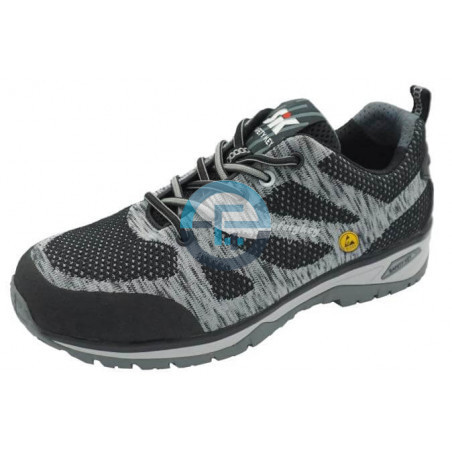
Eurostat Safetykey ESD
ESD safety shoe for multi-hazard industrial environments
Standard: EN ISO 20345 (safety shoe with 200 J toecap)
Markings: S1 PL SR FO HRO SC, IEC 61340-5-1 compliant
Designed for environments combining sensitive component handling and significant physical hazards: heat contact up to 300°C, presence of oils or hydrocarbons, slip risk, puncture exposure. The non-metallic PL midsole is compatible with metal detection portals. This is the typical profile for electronics manufacturing lines with industrial equipment, or maintenance work in an EPA.
Best suited for: electronics assembly, industrial maintenance in EPAs, environments combining ESD, heat and chemical hazards
View product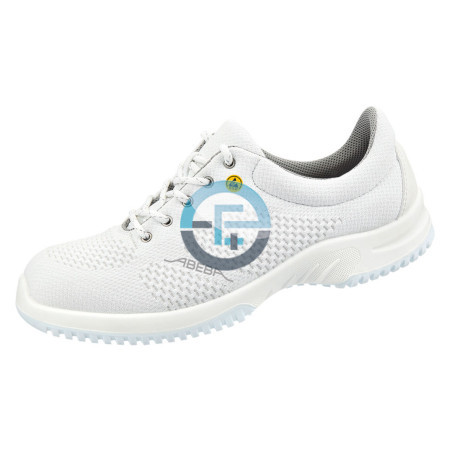
ABEBA UNI 6 White ESD
ESD occupational shoe for clean environments, no mandatory toecap
Standard: EN ISO 20347 (occupational shoe, no safety toecap required)
Markings: O2 FO SRC, IEC 61340-5-1 compliant, ABEBA ref. 36772
Knitted textile upper for maximum breathability during extended wear. The O2 marking indicates water penetration resistance without a protective toecap: this is suited to workstations where crushing risk is absent but hygiene, comfort, and ESD grounding are the priorities. White colour aids visual detection of contamination in controlled environments. Available in sizes 35 to 48.
Best suited for: cleanroom, laboratory, pharmaceutical, food industry, any clean EPA workstation without mechanical hazard
View product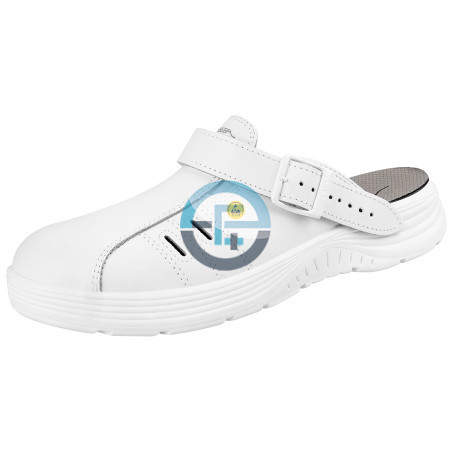
ABEBA x-light White ESD Clog
Ultra-light ESD safety clog with steel toecap, for hygiene-critical sectors
Standard: EN ISO 20345 (safety shoe with SB steel toecap)
Markings: SB A E FO SRC, IEC 61340-5-1 compliant, ABEBA ref. 7131041
Clog design for quick on/off, a key criterion in environments with strict dressing protocols. The x-light range is engineered to minimise weight during extended wear. The SB steel toecap provides protection against falling objects without the complexity of a laced shoe. Antistatic properties (A) and heel energy absorption (E) are included. Hydrocarbon resistance (FO) and slip resistance (SRC) complete the profile. Available in sizes 35 to 48.
Best suited for: medical sector, pharmaceutical industry, food production, any hygiene-protocol workstation with occasional mechanical risk
View productHow to select ESD footwear in practice
These are the questions to work through in order to reach the right model, without over-specifying or leaving gaps in protection.
- Does the operator work in an EPA? If yes, IEC 61340-5-1 compliance is mandatory. An antistatic marking (A) alone does not meet this requirement.
- Is there a crushing or falling object risk at the workstation? If yes, EN ISO 20345 with a 200 J toecap is required. If not, EN ISO 20347 may offer better comfort without compromising safety compliance.
- What are the physical hazards in the environment? Heat contact (HRO), hydrocarbons (FO), slippery floors (SRC), puncture risk (PL): each supplementary marking responds to an identifiable workstation hazard.
- Does the sector impose specific hygiene constraints? Medical, pharmaceutical, food production: white colour, clog design, washable materials, and water resistance point toward dedicated product ranges.
- Are the shoes worn all day? Weight, breathability, and heel energy absorption (E) directly affect operator acceptance and actual compliance in the field.
FAQ: ESD footwear and normative compliance
Can a standard safety shoe replace ESD footwear in an EPA?
No. A standard safety shoe is not certified for continuous grounding under IEC 61340-5-1. Even if it carries an antistatic marking (A), its electrical resistance may fall outside the range required for an EPA. Only footwear specifically certified as ESD and tested to IEC 61340-5-1 is compliant.
Does ESD footwear work on all floor types?
No. Operator grounding through ESD footwear requires a conductive or dissipative floor that is properly earthed. On a standard insulating surface, ESD shoes cannot fulfil their grounding function. In an EPA, the floor is part of the protection system and must be certified accordingly.
Should ESD footwear be tested regularly?
Yes. The electrical resistance of ESD footwear changes with wear, sole contamination, and usage conditions. Periodic verification with a footwear conformity tester is recommended and is often required under the quality procedures of IEC 61340-5-1 certified sites. A combined wrist strap and footwear tester centralises this check at the EPA entry point.
Can ESD footwear replace the wrist strap for grounding?
In certain contexts, yes: ESD footwear allows operator grounding while moving on a conductive floor, where a corded wrist strap is incompatible with the task. This depends on the site's ESD control plan. For seated workstations, the wrist strap remains the reference method for its reliability of skin contact.
Find the ESD footwear suited to your environment
Browse Eurostat's complete ESD footwear range: safety shoes for industry, occupational shoes for clean environments, clogs for medical and food sectors. All models are IEC 61340-5-1 compliant for operator grounding in EPA zones.
Browse all Eurostat ESD footwear