
 English
 Français
 Deutsch














Measuring, monitoring and neutralising electrostatic charges
Resistance meters, field meters, continuous monitors, ionisers and Prostat calibration: the instruments and methods to keep your EPA compliant with IEC 61340-5-1.
Resistance measurement
Why measure the resistance of ESD equipment?
Electrical resistance is the key parameter that determines whether ESD equipment (worksurface, mat, footwear, wrist strap) meets the requirements of IEC 61340-5-1. Resistance that is too low can cause currents that are dangerous for operators or components; resistance that is too high prevents charges from being drained properly. Periodic, documented measurement is a requirement of the standard.
What is the difference between a surface resistance meter and a volume resistance meter?
Surface resistance is the resistance between two points on the surface of a material (according to IEC 61340-2-3). It characterises the material’s ability to conduct charges along its surface. Volume resistance (or volume resistivity) is the resistance through the thickness of the material (also according to IEC 61340-2-3). In practice, modern ESD resistance meters measure both, using the appropriate electrodes.
How do I measure the resistance of a wrist strap?
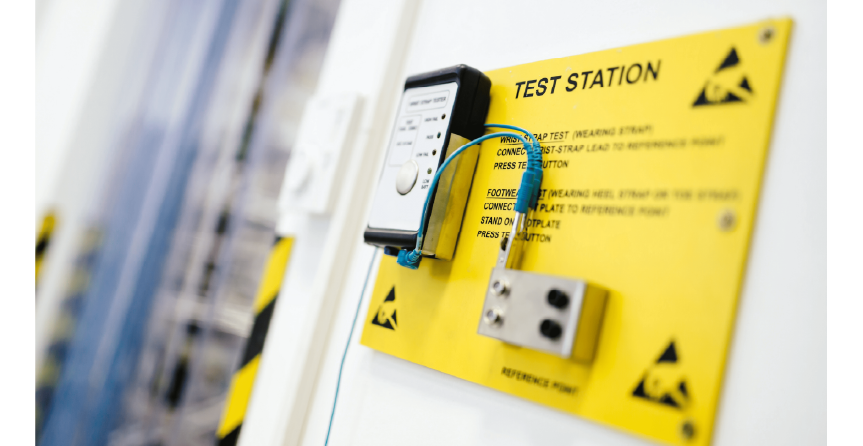
Wrist strap resistance is measured with a dedicated wrist strap tester, according to IEC 61340-4-6. The tester applies a defined voltage between the strap’s skin contact and the ground connection, and measures the total resistance of the assembly (strap + coiled cord). According to IEC 61340-5-1, the value must be between 750 kΩ and 35 MΩ. The operator must carry out this test at the start of each shift.
How often should the resistance of EPA equipment be measured and documented?
IEC 61340-5-1 requires a documented periodic verification programme, with frequencies defined in your ESD control plan. In practice: wrist straps are tested at the start of each shift, worksurfaces and floor mats are checked at least once a year (often quarterly, depending on criticality), and ESD footwear is tested according to the established plan. All results must be recorded.
Electrostatic field measurement
What is an electrostatic field meter and what is it for?
A field meter measures the electrostatic field around an object or surface, expressed in volts per metre (V/m). It is used to identify sources of charge in an EPA, check the effectiveness of ionisers and detect non-compliant insulating materials that could generate dangerous charges. It is an essential diagnostic tool during ESD audits.
What is the acceptable electrostatic field limit in an EPA?
IEC 61340-5-1 recommends limiting electrostatic fields in an EPA to below 100 V/cm (10,000 V/m) to avoid any risk of inducing charges on sensitive components. In practice, design targets are often below 1,000 V/m. Ionisation is the solution for neutralising fields in areas where insulating materials cannot be avoided.
Ionisation
How does an ESD ioniser work?
An ioniser generates positive and negative ions in the air by applying an alternating high voltage to pointed electrodes (emitters). These ions move towards charged surfaces and neutralise excess electrostatic charges. Ionisation is the only effective way to neutralise charges on insulating materials (plastics, glass) that cannot be grounded.
What types of ionisers are there and how do I choose?
The main types are: workstation ionisers (ionising fans on an arm or stand, covering a single workstation), ionising bars (for conveyors and production lines), blower ionisers (for larger areas or high-throughput workstations) and ionising guns (for occasional applications or dust removal). The choice depends on the size of the area to be treated, the production rate and installation constraints.
How do I check and calibrate an ioniser?
An ioniser is checked with a charged plate monitor according to IEC 61340-4-7. Two parameters are measured: discharge time and offset voltage. Discharge time must be below the value specified by the manufacturer, and offset voltage must stay within the limits defined by the standard (generally ±35 V). Ionisers must be checked and cleaned regularly according to the manufacturer’s recommendations, and calibrated annually.
Does ionisation replace equipment grounding?
No. Ionisation complements grounding; it does not replace it. It only deals with insulating objects that cannot be grounded. All conductive items (worksurfaces, equipment, personnel) must be grounded in accordance with IEC 61340-5-1. Ionisation is used in addition, to neutralise charges on the remaining insulating materials that cannot be eliminated from the process.
Continuous monitors and access control
What is a continuous wrist strap monitor?
A continuous monitor checks the resistance of the operator’s wrist strap continuously throughout their work. If the cord breaks, contact is poor or the strap is out of tolerance, a visual and audible alarm is triggered immediately. Unlike a spot tester (used at the start of a shift), a continuous monitor detects faults in real time, and it is often required in the most critical environments.
What is an EPA access control system?
An access control system (or compliance tester) automatically checks that the operator is compliant (working wrist strap, or ESD footwear and compliant flooring) before granting access to an EPA. It measures the resistance of the operator–equipment combination and only allows entry if the values are within the limits of the standard. These systems can be integrated into turnstiles or controlled-access doors.
Continuous monitor or spot tester: which should I choose?
A spot tester (testing at the start of a shift) is sufficient for standard-criticality environments where a failure during the day is acceptable. A continuous monitor is recommended for high-criticality environments (very sensitive components, low ESD withstand voltage), as it guarantees continuous protection. The higher cost of a continuous monitor is justified by the reduced risk of latent damage to high-value components.
Instrument calibration
Why calibrate ESD measuring instruments?
IEC 61340-5-1 requires all measuring instruments used to verify EPA equipment to be calibrated with traceability to national standards. An uncalibrated instrument can give incorrect readings and lead to non-compliant equipment being approved. Annual calibration is the recommended frequency in most EPA verification plans.
Does Eurostat offer a calibration service for ESD instruments?
Yes. Eurostat is officially recognised as a Prostat Authorized Calibration Lab. We calibrate ESD measuring instruments (resistance meters, field meters, wrist strap testers, charged plate monitors for ionisers) and issue a calibration certificate traceable to national standards. See our Services page for more information.