
 English
 Français
 Deutsch














Wrist straps, footwear, coats and gloves: equipping staff properly in an EPA
How to choose, test and maintain ESD personal protective equipment to ensure operator grounding and compliance with IEC 61340-5-1.
Wrist straps
How does an ESD wrist strap work?
A wrist strap creates a continuous electrical connection between the operator’s wrist and the common ground of the EPA. It consists of a conductive or dissipative band in contact with the skin, a coiled cord with a 1 MΩ current-limiting resistor (which protects the operator in case of accidental contact with an electrical voltage), and a plug that connects to the ground point. According to IEC 61340-5-1, the total resistance of the assembly must be between 750 kΩ and 35 MΩ.
How do I test my wrist strap?
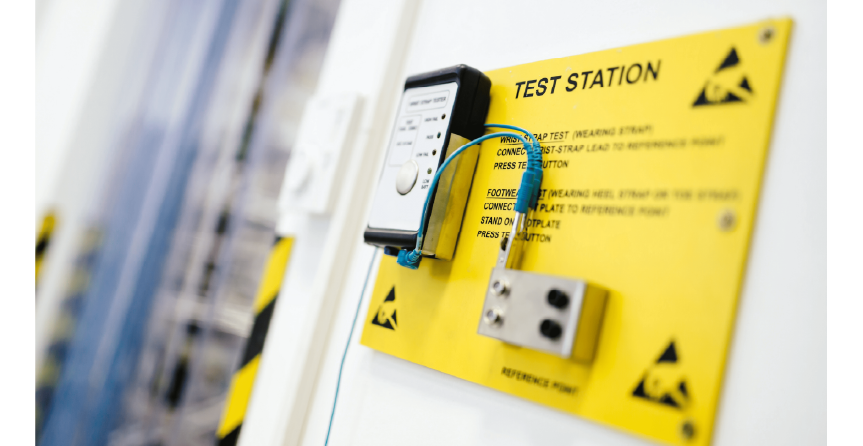
The wrist strap must be tested at the start of each shift with a wrist strap tester, according to IEC 61340-4-6. The operator plugs the cord into the tester, places the back of the hand on the contact electrode and presses the test button. The tester checks the total resistance of the assembly and shows a green (pass) or red (fail) light. If it fails, the wrist strap must be replaced immediately, before any sensitive components are handled.
How long does an ESD wrist strap last?
An ESD wrist strap has no fixed service life, but it must be replaced as soon as it fails the compliance test. The most common causes of failure are a broken cord (often at the connectors), wear of the band itself, or poor contact between the band and the skin. Daily testing allows faults to be detected quickly, before they cause damage.
Can a wireless wrist strap be used?
No. So-called wireless (or cordless) wrist straps do not provide any path to ground and are not recognised by IEC 61340-5-1 as a method of grounding personnel. They must not be used in an EPA in place of a corded wrist strap or ESD footwear.
ESD footwear
What is the difference between ESD footwear and antistatic footwear?
Antistatic footwear (AS marking) has a resistance between 100 kΩ and 1,000 MΩ: it reduces the build-up of static charge on the operator but does not guarantee effective grounding. ESD footwear (ESD marking, tested to EN 61340-4-3) has a lower resistance and meets the specific requirements of IEC 61340-5-1 for use in an EPA. In an ESD environment, only footwear certified as ESD is compliant.
ESD footwear or wrist strap: can I choose either?
Yes, with conditions. IEC 61340-5-1 accepts two systems for grounding operators: a wrist strap (the most reliable, as it is permanent), or ESD footwear combined with ESD flooring. With footwear, effectiveness depends on continuous contact between the soles and the floor, which can be interrupted by movement or certain postures. The wrist strap remains the preferred solution for fixed, high-criticality workstations.
How do I test and check ESD footwear?
ESD footwear is tested according to IEC 61340-4-3. The tester measures the resistance between the sole and an electrode placed inside the shoe (or via a sensor plate on the floor). The resistance must meet the specification. Test frequency is defined in your EPA verification plan. Note that soles get dirty over time and their resistance can increase, making the footwear non-compliant even without any visible defect.
ESD coats and garments
When is an ESD coat mandatory?
An ESD coat is required when the operator’s personal clothing (synthetic fabrics in particular) could generate significant electrostatic charges near sensitive components. IEC 61340-5-1 recommends wearing one when personal clothing presents an identified risk. In practice, high-criticality environments (aerospace, defence, semiconductors) systematically require ESD coats.
How do ESD coats work?
ESD coats are made from fabrics with conductive fibres (carbon or metal fibres) woven into a regular grid. This structure forms a partial Faraday cage that limits the effect of charges generated by personal clothing. They must be grounded, either via the wrist strap worn under the coat or via conductive snap fasteners connected to the ground cord.
How do I wash an ESD coat without affecting its properties?
ESD coats must be washed according to the manufacturer’s instructions (generally machine-washed at 30–40 °C, without fabric softener, which leaves an insulating layer on the fibres). Tumble drying should be avoided or limited depending on the fabric specifications. After a certain number of washes (which varies by model), the dissipative properties may deteriorate: check coats periodically with a resistance meter according to IEC 61340-4-9.
Gloves and hand protection
Can gloves be worn in an EPA, and which ones?
Yes, specific ESD gloves exist for operators who cannot work bare-handed (chemical risks, particle contamination, protecting components from fingerprints). These gloves are made from dissipative materials (conductive nitrile, fabric with conductive fibres). Note that standard latex or vinyl gloves are insulating and are not compatible with an EPA. The wrist strap must be worn on the skin under the glove to maintain the ground connection.
Can ESD finger cots replace gloves?
ESD finger cots are a lightweight alternative to full gloves, used to protect components from fingerprints and moisture while preserving dexterity. They must also be dissipative or conductive. They do not replace gloves in environments that require chemical or mechanical protection, but they are widely used in precision electronic assembly.
Grounding and accessories
What is an ESD ground point and how is it installed?
An ESD ground point is a connection point fitted to the workstation or wall and connected to the common ground of the EPA. It accepts plugs from wrist strap cords, mat cords and equipment. It must be installed by a qualified electrician and checked to ensure continuity to the building ground. The resistance between the ground point and the electrical earth must be less than 1 ohm.
Can the standard electrical earth be used as the ESD ground?
Yes, provided it is checked. The ESD ground can use the building’s protective electrical earth (the PE pin of electrical sockets), provided this earth is correctly installed and checked. The electrical neutral must never be used as an ESD ground. A qualified electrician must check the installation before commissioning. In some cases, a dedicated, independent ground may be needed, depending on the quality of the existing electrical installation.