
 English
 Français
 Deutsch












Combining ESD protection and contamination control in the cleanroom
ISO 14644 classes, low-particle packaging, cleanroom-compatible coveralls and gloves: answers to the specific constraints of ESD cleanroom environments.
Cleanroom basics
What is a cleanroom and what are the ISO classes?
A cleanroom is a controlled environment in which the concentration of airborne particles is kept below defined thresholds. ISO 14644-1 defines cleanliness classes from ISO 1 (cleanest) to ISO 9. ISO class 7 (formerly class 10,000) is common in electronics, while ISO classes 5 and 6 are used for semiconductors and medical devices. Each class imposes strict constraints on the materials, equipment and procedures used.
Why is ESD protection necessary in a cleanroom?
Components processed in cleanrooms (bare dies, wafers, MEMS, optical devices) are often among the most ESD-sensitive, due to their advanced technology and extreme miniaturisation. In addition, low-humidity cleanroom environments encourage the build-up of electrostatic charges. ESD protection is therefore doubly critical and must be managed alongside particle contamination control.
What is the main difficulty in combining ESD control and cleanroom requirements?
The main difficulty is that some standard ESD solutions can be incompatible with cleanroom requirements. For example, the conductive fibres in ESD coats can shed particles, the adhesives in marking tapes can outgas, and some dissipative materials can release ions or particles. Every product used in a cleanroom must be qualified for the relevant ISO class in terms of particle emission and outgassing, in addition to its ESD properties.
Cleanroom-compatible packaging
What is cleanroom-compatible packaging?
Cleanroom-compatible packaging is qualified for a given ISO class: it generates minimal particles when handled, does not outgas chemicals that could contaminate components, and also meets ESD requirements. This packaging is often produced in a controlled environment, packed clean and delivered in an outer protective wrap to be removed before entering the cleanroom.
Which thermoformed trays are cleanroom-compatible?
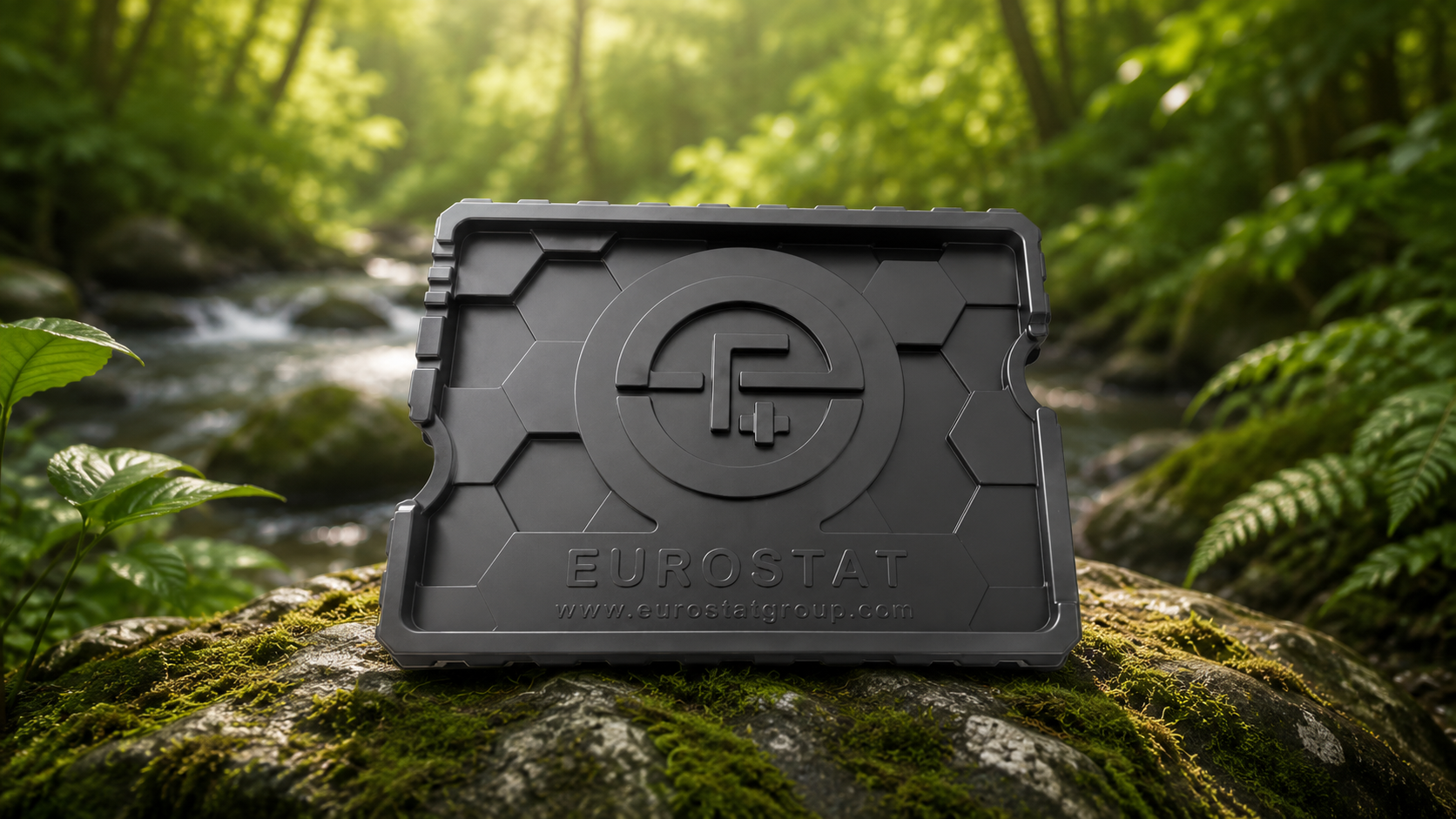
Cleanroom-compatible thermoformed trays are made from low-particle dissipative materials, without plasticisers or additives that could outgas. Eurostat’s Clear-STAT material, which is transparent and dissipative, is particularly well suited: it allows visual inspection without unnecessary handling and has low outgassing. Trays must be cleaned, packed and delivered according to the protocols for the target ISO class.
Can standard shielding bags be used in a cleanroom?
Standard shielding bags are generally not qualified for the strictest cleanroom classes (ISO 5 and below), as their surface can shed particles when handled. Specifically cleanroom-qualified versions exist, with low-particle surfaces and compatible inner materials. For ISO classes 7 and 8, a case-by-case assessment is needed based on your process requirements.
Personnel equipment in the cleanroom
Which coveralls and coats are compatible with both cleanroom and ESD requirements?
ESD cleanroom coveralls are made from lint-free fabrics with integrated conductive fibres, qualified for the relevant ISO class. Seams are heat-sealed (no exposed thread) to minimise particle emission. They must meet both electrical resistance requirements (IEC 61340) and particle emission tests (ISO 14644). The grounding wrist strap must be worn under the coverall, with an accessible connection point.
Are cleanroom gloves compatible with ESD requirements?
Gloves combining cleanroom properties (lint-free, low particle emission, powder-free) and ESD properties (dissipative) are available. Clean, dissipative nitrile gloves are the most common. They meet the requirements of the relevant ISO class while maintaining the required ESD properties. The grounding wrist strap must be worn on the skin under the glove to maintain an effective ground connection.
Is standard ESD footwear compatible with a cleanroom?
In most cases, no. Ordinary shoes (even ESD shoes) are not allowed in cleanrooms because they generate too many particles. ESD cleanroom overshoes or dedicated cleanroom shoes with conductive soles are used instead. This equipment must be qualified for the relevant ISO class and checked periodically for its electrical properties according to IEC 61340-4-3.
Procedures and best practices
How should materials be transferred into the cleanroom while respecting ESD requirements?
Transferring materials into a cleanroom generally follows a multi-step protocol through transfer airlocks. Outer packaging (not cleanroom-qualified) is removed in the airlock and replaced with compatible packaging. Ionisation in transfer airlocks neutralises the charges generated when packaging is opened. Container surfaces are cleaned with suitable products before being brought into the cleanroom.
Can Eurostat supply products qualified for my specific ISO class?
Yes. Eurostat offers cleanroom-qualified products for different ISO classes. Product data sheets specify the compatible classes. For specific needs (a particular ISO class, strict outgassing requirements, documented compliance tests), contact our technical team, who can guide you to the right solutions or carry out characterisation tests in our laboratory.